Tuesday, March 1, 2016

Nepal: HelpX


En la última publicación , escribí de mis experiencias quedándome en un pueblo cerca de Katmandú, que se llama Changu Narayan. La casa familia  en que me quedé por tres semanas fue interesante porque, además de ofrecer alojamiento a viajeros, los dueños aceptaban a voluntarios a través de un sitio de Internet que se llama Helpx.

Usando Helpx, viajeros (en su mayoría mochileros) pueden buscar a oportunidades para hacer trabajo voluntario a lo largo del mundo. Helpx es un sitio de "trabajo intercambio",  y bajo esta idea mochileros pueden trabajar para un hostal, un negocio (como un restaurante o algo similar) o para organizaciones sin ánimo de lucro (como escuelas). Los voluntarios suelen trabajar cuatro o cinco horas por día, por comida y una habitación.

Una captura pantalla de la página principal de HelpX. 


El dueño quería tener más huéspedes y voluntarios, quiene trabajaban en su granja (él tenía una granja cerca de su casa). Así, decidí quedarme más tiempo en su lugar para ayudarlo atraer más voluntarios. Me metí en el Internet y encontré dos sitios similares a Helpx -- Workaway y HelpStay. Durante dos semanas, escribí listados en estos dos sitios, y me ocupé de contestar correos de voluntarios y arreglar  el calendario de reservas para voluntarios. Fue trabajo muy interesante, y aprendí mucho durante mi estancia.

Un listado de Workaway.


Sunday, February 28, 2016

Nepal: Changu Narayan y los cortes de electricidad.


Después de unas semanas en la ciudad frenética que es Katmandu, me sentí lista para el silencio del campo. Y, por eso, me mudé sólo una hora de Katmandu al pueblo pequeño de Changu Narayan. Me encanta que en Nepal no tenga que viajar distancias largas a ver sitios interesantes, incluso en el valle de Katmandú hay cientos de lugares, templos y pueblos fascinantes.

Changu Narayan está ubicado a la cumbre de una colina, y las vistas de Katmandú y el campo son pintorescas. Estuve en Changu Narayan por tres semanas a finales de la temporada de lluvias, así que, el paisaje fue muy verde. Pasaba muchas horas sentada en el balcón de mi alojamiento, sólo mirando la vida de Nepal rural, ocurriendo delante de mis ojos.


La vida rural en Nepal casi no ha cambiado por siglos, con la excepción de la introducción de electricidad hace quizás diez o quince años. Y, incluso la electricidad no funciona por muchas horas cada día. Hay cortes en todo el país que dura entre seis y doce horas todos los días (depende de la estación, en el invierno los cortes son más largas). Y, por supuesto, hay una aplicación por eso; se puede descargar una aplicacción con horario de los cortes de cada región del país. Aunque, si no tienes electricidad para cargar el teléfono, no sea posible ver la aplicación. Jejeje...la ironía.


Estos cortes también significa que mucha de la población de Nepal no puede tener una nevara, o usa aparatos eléctricos o ordenadores por mucho del día. Cuando estuve en Nepal, me di cuenta de la importancia de tener cosas básicas, como electricidad. ¡Y me di cuenta que es muy difícil desarollar un país sin cosas como electricidad!

En Changu Narayan, me quedé en una casa familia, que los padres de la familia se ha convertido en un alojamiento para mochileros. La acomodación se llama "Village Villa  Chambre d'Hotes". Era muy cómido y tranquilo durante la noche, y cuesta $15 por noche, incluso de comida. Pero, la casa no tiene agua caliente, ¡que sería problemático en el invierno!


Saturday, February 27, 2016

Nepal: la ciudad de Kathmandu

 ¡Hola tod@s!

Me llamo Emma, soy australiana y estoy aprendiendo español. He decidido escribir este blog en español así que puedo practicar el idioma. ¡Vas a encontrar muchos errores en mis mensajes...lo siento en adelanto!

Durante 2015, me quedé cinco meses en Nepal. Quizás ya sabes que Nepal fue afectado por un terremoto muy fuerte en abril de 2015, y el país todavía está recuperando después este horrible evento. La mayoría del país pequeño no fue afectado por el terremoto, pero el área de el valle de Kathmandu, una parte del país con muchas atracciones turísticas, fue el centro del terremoto.

Aquí te tienes unas fotos del impacto del terremoto en Kathmandu. Los obreros en las primeras fotos están desmantelando la escuela más antigua de Nepal...¡Qué triste....porque era un edificio muy bonito! Afortunadamente, cuando golpeó el terremoto, los niños no estuvieron en las escuelas.


Me quedé dos semanas en el centro de Kathmandu, y, aunque no me esperaba que la ciudad fuera tan interesante, en realidad me encontró muy anciana y pintoresca...aunque muy ruidosa también. Hay tantos templos hindúes en el centro de Kathmandu, y también en los alrededores. Se puede pasar una o dos semanas por lo menos sólo explorando los templos en el valle de Kathmandu.

Aquí te tienes más fotos del centro histórico de Kathmandu  (y de los vendedores de manzanas...¡los nepalis están muy orgullosos de sus manzanas dulces!)


El método de transporto muy commún en las calles pequeñas del centro de Kathmandu es el jinrikisha (rickshaw). ¡Pueda parecer muy romántico a viajar en un jinrikisha pero la realidad es que es muy incómodo!

En Kathmandu, yo me quedé en un hotel fantástico...el gerente, el dueño, y los empleados eran tan simpáticos y amables. Y el hotel es muy bien ubicado en el centro de la ciudad, cerca de atracciones turísticas. También, es tranquila durante la noche. El hotel se llama "Hotel Happy Home"...tiene muchas reseñas buenas en Trip Advisor. 

Wednesday, October 28, 2015

Medaka Family School


I just got back from ten days in Saping, a rural farming village up in the mountains. The people running the guesthouse I've been staying at come from the village and started a school there around ten years ago. They wanted to get more volunteers, so for the past few weeks I've been putting the school on some different volunteering websites, and we all went up to the village together with the first 'batch' of volunteers!

Sitting outside the school with some of the volunteers
The village is usually 2 hours bus-ride plus a 2 hour walk from where I'm staying, but because I couldn't do the walk, we hired a 4WD to take us up...there were 7 people in the dual-cab in the front and another 9 in the back...everyone was so happy not to have to walk two hours up the mountain to the village that we practically had a whole village in the truck with us!

I had to pay a bloody fortune for the truck because of the fuel shortage. It is just crazy here now...people in Kathmandu are having to chop down trees to get firewood for cooking, no medications are getting in, so the hospitals are desperate, and about 10% of the buses are running. Here's a photo of people piled on top of one of the buses, it's just so dangerous because the roads are very windy and not in good condition.


The village was just amazing, it was like stepping back in time 100 years. Most people survive on subsistance farming, and the views were great. This is the dawn view from my bedroom window...


I was there with a French artist, so we all helped do a little art project with the kids.


And I did a bit of embroidery with them. 


Then it was time for the Dashin Festival, which is the biggest Hindu celebration in Nepal. The other volunteers got up at 5am and walked up a mountain for 3 hours to see the ritual slaughter of hundreds of goats and buffalos...apparently it was very gory. They killed the animals over a large rock and then poured coconut milk over the blood as a sacrifice to one of the Hindu Gods. This is some of the guys carrying the goats back down...


Then we all went to a little ceremony to get these 'tikas' put on our foreheads to bring good luck for the next year...they were made of yoghurt and rice, a bit like having a rice crispy on your forehead!!


Over Dashain; the kids make these amazing swings from bamboo poles and rope and spend days lining up to swing on them.


After the other volunteers left I went on a few little walks around the valley with some of the relatives of the director of the school. The oldest boy in this photo used to go to the school but now has to walk three hours a day to get to and from his high school!! 


The school is the long rectangular building in the upper LH corner of the photo.


Lots of earthquake damage in the area, most people were sleeping or living in corrugated iron sheds.
The nearest thing to a piano they have!


Then it was time for school to start again. The school building is very basic, but given that so many of the children weren't even going to school before it started, it is giving these kids a good chance at at least knowing how to read and write.


Here are some photos of some pages from the textbooks...to give you an idea of what the standard of English teaching is like! 


Friday, October 9, 2015

The Himalayas!!


So here I am in rural Nepal, lying around waiting for the lights to come on. The government can't give the population electricity (because it's selling it to China), but it does generously publish a timetable (yes, there's an app for that) to tell them which 8 hours of the day they won't be able to do anything much....and then never sticks to the timetable!! 

I can see why so many international development campaigns focus on electricity, because it's just so hard to grow an economy without it.  Almost all the business' around here do things that don't need it; in the village I was staying in last month there was one shoe-maker and two tailors (all using the Singer treadle machines)...but the nearest internet cafe was 20 minutes away by bus! 

 I went to get some photos printed in Kathmandu last week and the owner of the store told me I could come back to pick them up in three hours, when the electricity came on! Imagine trying to run a business like that.


I spent a couple of weeks staying on the outskirts of Kathmandu and met some lovely people there. I ended up doing a visit to the local school with the girl in this photo and sitting in on a Nepali history class. It was all very raucaus; the class consisted of one student reading out loud from a textbook for 20 minutes while everyone else (including the teacher) talked over the top of her! 


After that, I went to stay for a few weeks at a homestay at the top of this hill and did some marketing for the owner.


The name of his guesthouse is pretty much a textbook example of what NOT to name your business when you have just a cold-water tap in the bathroom along with a very dirty bucket (like the one in this photo but much, much dirtier) which have to multitask as shower, toilet flusher, sink and toilet paper!! (Don't think too much about that last one.)

I think the Nepalese invented the concept of layering!
The name of the homestay is "Village Vil!a Chambre  d'Hote. I don't know what French nong came up with this ridiculous 5 star hotel name.  The last word, which you'd think would be "hotel" actually means breakfast in French! 

The homestay
I tried to explain to Dhruba, the owner, that apart from this being a name that no non-French speaker would ever remember, it was also misleading, because French words are used in English when we want to make a product sound luxurious. So, even though non-French-speakers wouldn't understand the words they were reading, it would signify "expensive," and turn off budget travellers! Unless he was going to call the place "Dirty Bucket Homestay" I actually can't think of a worse name.

With Karo, a volunteer from NZ
Anyway, as you can imagine, my suggestion to shorten the name to "Village Villa Homestay" was met with a lukewarm reception. Fair enough...it's a big ask, and I fully expected he would say no.  People are very attached to the name of their business, and also, he couldn't see what I was saying about French names being posh.

 So, no name shortening, but I did help out with bringing more volunteers to stay at his place. (They are helping on his farm and also in the village, which was affected by the earthquake). When I arrived the first time I was the only guest...and a few days ago he rang in a bit of a panic to say there were eleven people staying there (in three rooms!!). If I was still there I'd be holed up in one room like the neurotic sleep-Nazi I am, and 5.5 people would be in each of the other two, so I think he was pretty glad I was gone!

Here are a couple of village photos. 


View from the homestay
They are drying the corn to make flour from it.


The pace of life here probably hasn't changed much in hundreds of years. Apart from in the guest bathroom, there is no running water in the house; all the water is collected at the communal well, which also functions as a shower and laundry. There's no sink or even benches in the kitchen...all the cooking is done on the floor, and the dishes are done outside (with chickens taking advantage of the food scraps!).


This is Minuka, Dhruba's wife, using this cool curved knife that you hold down with your foot. 
Minuka with curved foot-knife
I went to a puja with the women of the family. A puja is kind of a Hindu gathering and this one was to celebrate the end of Taaj, a festival where women fast and pray for three days for a long life...for their husband!! (Insert feminist side-eye emoji).


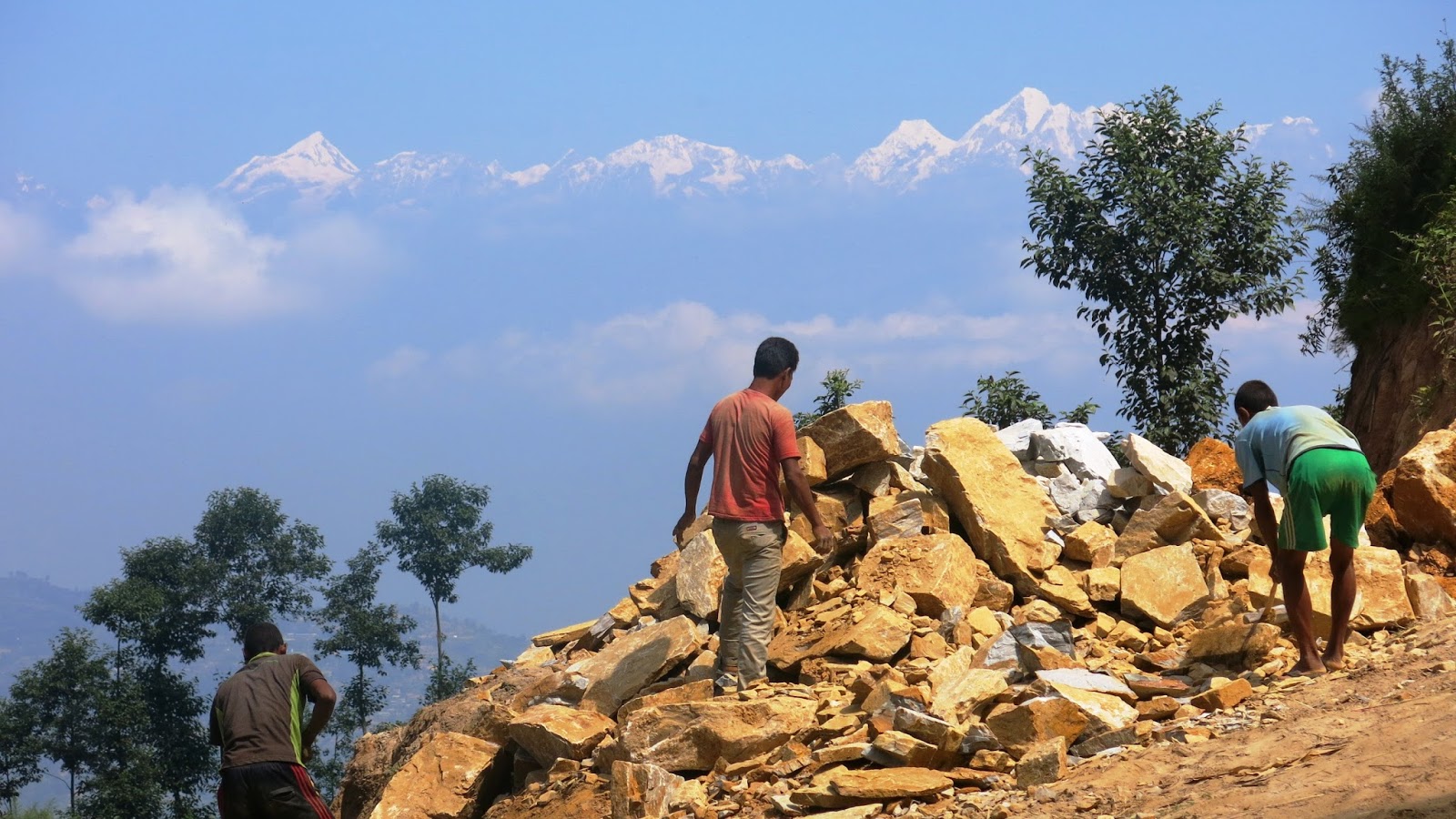
About two weeks agoI left that village and came to a town called Dhulikel, which is 2 hours from Kathmandu, and famous for its vistas of the Himalayas. They are really stunning, but difficult to capture in a photo. Sometimes you only see the tops of the mountains, and they look like they are floating across the sky above the clouds. Some photos from here: 


View from my room in the first place I stayed in here.
I really like the place I'm at now. The people who run the guesthouse are from a village about 3 hours from here (1.5 hours by bus and 1.5 hours walking). They have a school there which was set up to educate girls for free, because they often weren't being sent to school. (There's a traditional here of not educating girls, because once they marry they belong to the husband's family so won't be of any economic benefit to their parents.) 

Nani getting me ready for winter!!
Nani, who used to teach at the school and now runs my guesthouse, want more volunteers, so I've been putting the on different volunteering websites. They've only been on them for a few days, and we've already had four queries from people interested in coming, so that's a good sign. The village was affected terribly by the earthquake; about 70% of people are living in corrugated iron shelters, waiting for rebuilding of houses to start. There's one US volunteer who wants to come who is a structural engineer, which would be really handy. 

I'm hoping to go up to the village next week, but India is pissed off with Nepal at the moment so is blocking all imports  at the border...so there is no petrol available, and I might not be going anywhere (along with the rest of the country). 

Check out this home-made dog collar...it is to stop leopards attacking the dog!!


Bonus crazy goat photo!!